This month the Year 5s have been lucky enough to receive a couple of visits from Deborah Whitworth-Hilton, a director of the international engineering company, Uniper, one of the world’s largest producers of low carbon power.

This was part of a summer STEM partnership project initiated by the CIEC – the Centre for Industry Education Collaboration –designed to bring STEM ambassadors and primary schools together, to work on specific CIEC projects.
Each school taking part was allocated a £150 budget to spend on science equipment relating to the activities undertaken.
Deborah was a perfect fit for the Year 5s, as they have been studying renewable energy sources as part of this term’s geography topic and were therefore very interested in the subject, and keen to learn about Deborah’s real-life experiences.
Our first session took place on the morning of Wednesday 10th July. Deborah talked to the class about her work and what inspired her to become an engineer. We learned much about Uniper – including how the company got its name. This was a question from one of the Year 5s, and the answer was that it was the result of a name competition held by the company, and it stood for Unique performance.


We also discovered that there is a huge underground gas storage system in Holmes Chapel where 165 million cubic metres of methane is stored. This cavern was created by drilling down ½ mile into the ground, melting the salt and extracting the solution. This left a 100m wide by 100m deep space for gas. The children were fascinated by some of the objects that Deborah brought with her, including large pillars of pure salt extracted from underground and PPE equipment, which the children enjoyed putting on.
Following Deborah’s presentation, the Year 5s were tasked with building a wind turbine, based on the activity ‘Wind Power’ in CIEC’s Generating Electricity project. This involved attaching a cardboard template to a piece of dowel which had been inserted into a plastic bottle. We used a hairdryer to act as the wind source, which wasn’t that effective, until the children decided to design their own blades. Deborah was on hand in her engineering capacity to offer advice on blade shapes and suggest potential improvements to the existing template.


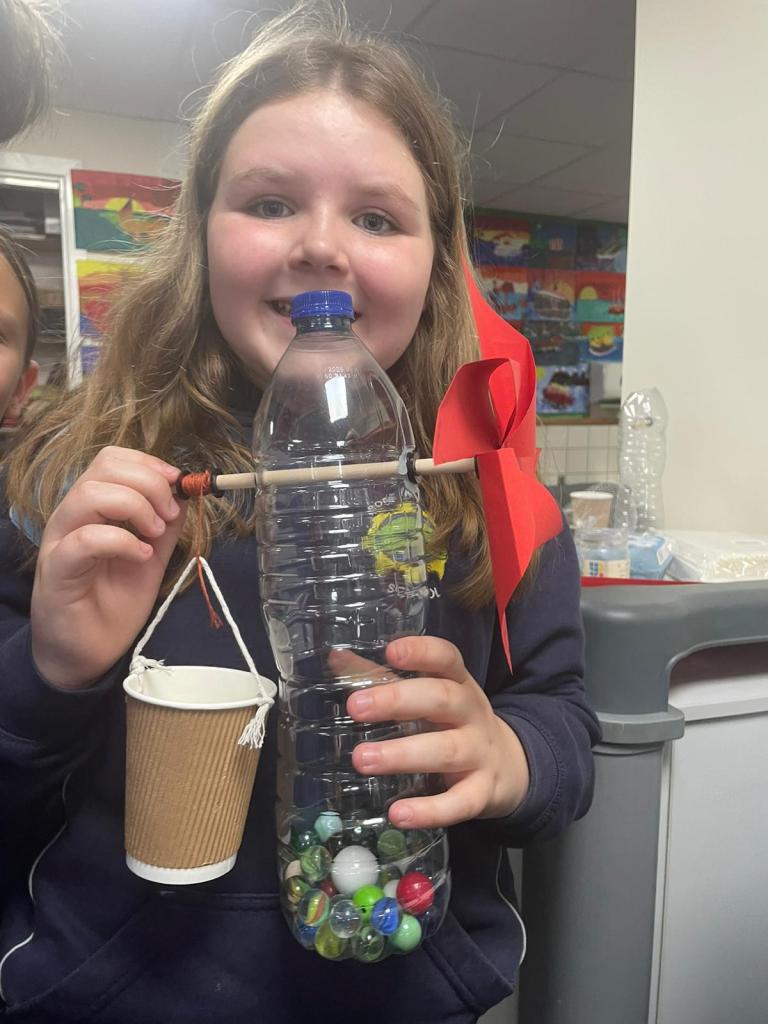

Interestingly, many of the girls excelled at this process, showing a determination to create a model that lifted the paper cup more easily off the floor.
Changing the shape of the blades.
At lunchtime, Deborah had to leave for a business meeting, however before she left, she launched a competition for the Year 5s to design a Future City.
Our next session is based around which plant-based materials offer the most sustainable source of energy. It will be interesting to see what the results are.
 Think Like An Engineer