Linking Engineering with Literacy

One of the main obstacles to introducing Engineering into the primary curriculum has to be the perceived need to focus on English and Maths, which leaves very little room for anything else, let alone a new subject.

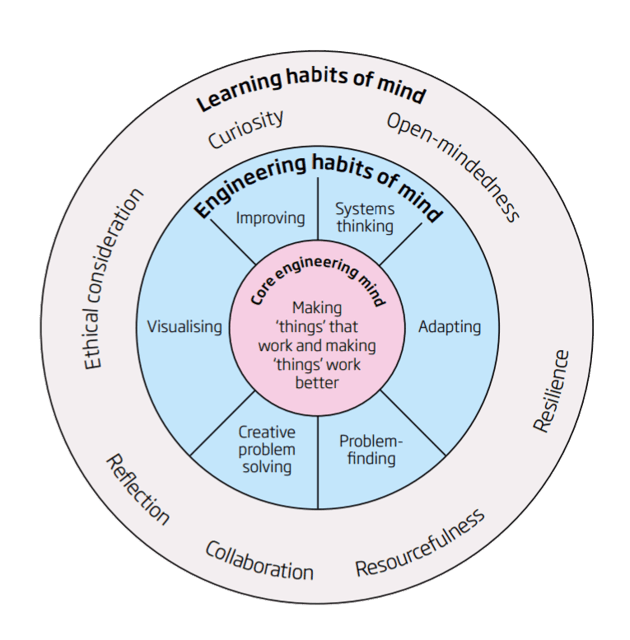
That is why introducing Engineering Habits of Mind (EHoM) is key. For those of you unfamiliar with this term, these are characteristics that engineers have said that they use when carrying out their day to day jobs and were highlighted in a report commissioned by the Royal Academy of Engineering:  https://www.raeng.org.uk/publications/reports/thinking-like-an-engineer-implications-full-report

Engineering habits

These six ‘habits’ (highlighted in blue in the above diagram) fit perfectly into all areas of the primary curriculum, and nowhere more so than Literacy. little miss inventor

Think about it: –

  • Systems Thinking
    • understanding how the different components of a piece of writing fit together
  • Creative Problem Solving
    • generating concepts, themes, characters, plots, dilemmas
  • Visualising
    • story maps, flow charts, mind maps, creating a picture in your head
  • Adapting
    • changing the genre to suit the audience and purpose
  • Problem Finding
    • proof reading
  • Improving
    • editing work


Not only that, but we can read both fiction and non-fiction books related to Engineering and produce associated writing. But how can we truly embed engineering concepts into our Literacy lessons?

Last week I had the pleasure of running a number of sessions with Gemma Taylor, on the two day ‘Teaching engineering in the primary classroom’ course – one of which was entitled ‘Engineering in Literacy’.

The focus of this session was to show teachers how they could take their class text and incorporate engineering into their teaching – something we have been doing for the past 18 months at Rode Heath Primary. 

The principle is fairly simple.

  1. Pick a book
  2. As you are reading it, consider what challenges the main character faces.
  3. How does the character solve his/her problems.
  4. Could the problem be solved by engineering?

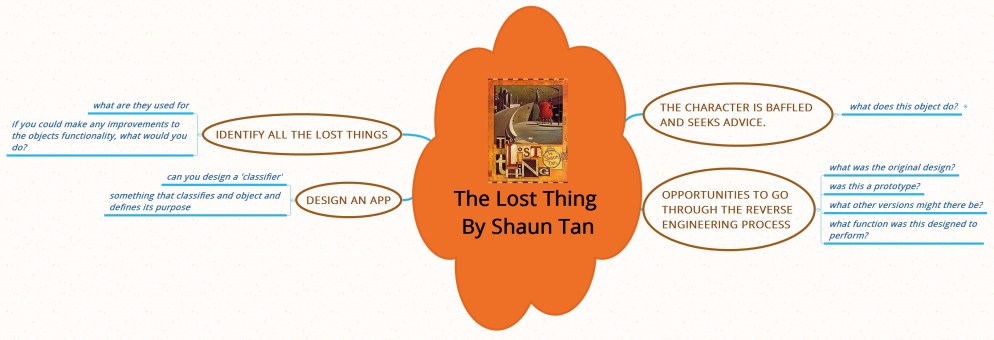
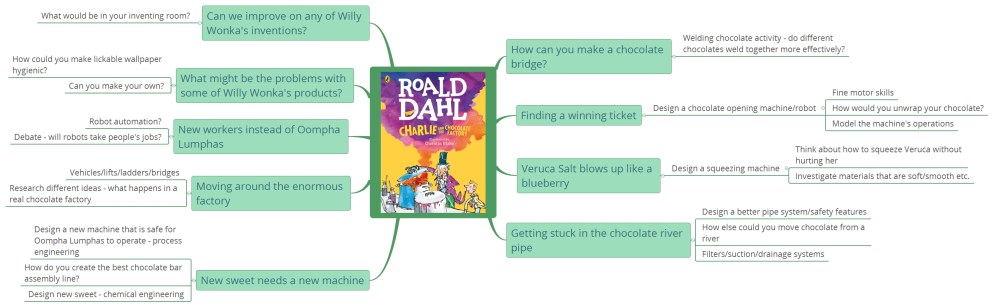
We were lucky enough to have stunning group of delegates, who had brought a selection of fiction texts with them from the classic A Christmas Carol to Shaun Tan’s The Lost Thing. Together we spent an hour creating a series of mind maps which can be seen below:- 

A Christmas Carol map

The Lost Thing by Shaun Tan

Ideas for Charlie

Spiderwick ideas

The London Eye Mystery ideas

Stormbreaker ideas

Two Towers ideas

I was a rat ideas

holes ideas

Once your children have gathered a set of ideas, discuss which of them might feasibly be solved by engineering. Then have a go: –

  • Design functional, realistic, appropriate solutions
  • Engage in the Engineering Design Process
  • Improve designs
  • Present solutions

You don’t even need to make your products – just create the designs on paper and encourage the children to talk through them.

Here’s an example that our Year 1 teacher, Miss Moss, developed with her class.

Her topic in Year 1 in the spring term was ‘Superheroes’.  We have been learning all about heroes, fictional heroes and real-life heroes.  The text was ‘Supertato’, a superhero amongst his fellow vegetables especially when the Evil Pea escapes from the freezer and causes chaos in the supermarket.

This slideshow requires JavaScript.

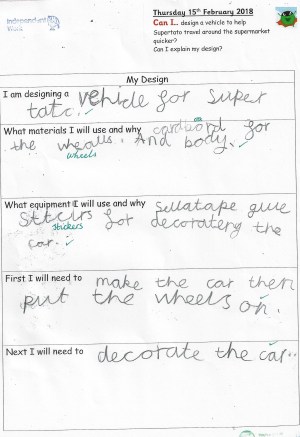
“The children realised from the text that their superhero didn’t always catch the ‘Evil Pea’ first time and often he had to give chase around the supermarket.  The children decided they needed to invent something that would help Supertato catch the Evil Pea.  After much deliberation they come up with a vehicle that would help Supertato travel around the supermarket faster than he was already doing.

There are often many steps involved in designing a vehicle but some of this also has to be through exploration.  I gave the children a problem and asked them to think of a way to solve this problem.

I gave the children a variety of materials to begin including Lego, Duplo and Magformers.  The children quickly began to design vehicles to help supertato.

Once the children had started I gave them a potato and we discussed some of the things that their vehicle would need.

 This is how we came up with our success criteria:

  • Is this vehicle the right size? – most were not until I gave them a potato and then they thought carefully about their vehicle design
  • Will Supertato be secure? – The potato being the shape that it is gave the children a whole new problem to solve. Could they keep the potato in the vehicle?
  • Would this help Supertato to move quickly around the supermarket? – The children found this the most challenging. The potato was quite heavy so some designs just wouldn’t move because of the weight.  The children looked at the designs of others and quickly realised that those that were being pushed around were slower and those that had wheels were moving along a lot quicker.

This gave us our next focus – wheels!”

We have found that the benefits for Literacy are wide reaching: –

  • increased engagement in reading
  • more attentive – searching for problems
  • collect evidence from text
  • purposeful writing opportunities
    • write a letter to the character explaining your invention
    • rewrite a scene in the book which incorporates your idea
  • increased imagination and creativity

It’s definitely worth having a go! Let us know how you get on.

Thank you to: Louise Atkinson, Ross McTaggart, Lauren Bain, Sarah Elmer, Sarah Entwhistle, Liz Jackson, Lisa Larham and Laura Thompson for your mindmap input.

Reaping the benefits

Sometimes you wonder when you go against the grain, whether you are following the right path. Trusting your instincts can be a lonely and often challenging experience. At Rode Heath, for the past 18 months, we have persevered in our belief that teaching children to think like engineers – to problem solve, visualise, adapt and improve – will have huge benefits in the long term.

Already, we are hearing from KS1 staff that the Year 2s have shown increased resilience this year whilst taking their SATs – a fact that we would attribute to our engineering project. And, this week the Year 4s have demonstrated their creative problem solving skills on a number of occasions during their residential visit to Quinta.

The activity that most springs to mind was the raft building activity led by the excellent Joe, from http://freaxadventures.co.uk/.

This year, a more structured approach to the raft building was taken, with a clear focus on the engineering design process. This was the first time that the activity had been delivered in this way. Normally, the children are given a set of materials and challenged to build; however, we started with some questions about structure and design and the children were tasked with first coming up with a design on paper.

Questions to consider were: –

  • how many people does it take to sink a barrel?
  • how do we spread the weight of the children and teacher?
  • what shapes are the most rigid?
  • would a wide or narrow platform be more stable?

Some interesting ideas were generated and discussed.

The next stage was to make a model using a variety of different sized sticks. This was a great idea as it really helped the children to visualise their drawings and provided a set of clear steps to construct the life-sized craft. Moreover, it reinforced the benefit of knowing exactly what materials you would need to use – something that engineers do in real life to keep costs down and improve efficiency.

The children came up with these stages in the production process:

  1. First create a square shape to hold in the barrels. Lay down the barrels to work out the size that the square needs to be, as it is important to make sure that they are tightly fitted.
  2.  Separate the barrels with a piece of wood. This will keep them in situ and help stabilise the raft.
  3. Put a couple of extra pieces of wood on top to make the barrels even more secure.  (Actually, when the raft was finished, the children decided that this step was unnecessary.)

Obviously the logs needed to be tied together, so the children had to learn how to tie a series of knots, the most important of which was the clove hitch.

Once the clove hitch has been tied, then the two logs are sandwiched together by a technique called box lashing. This is followed by throttling (all excellent terms) and finally, to tidy everything up, you tie a shoelace knot (reef to those in the know!)

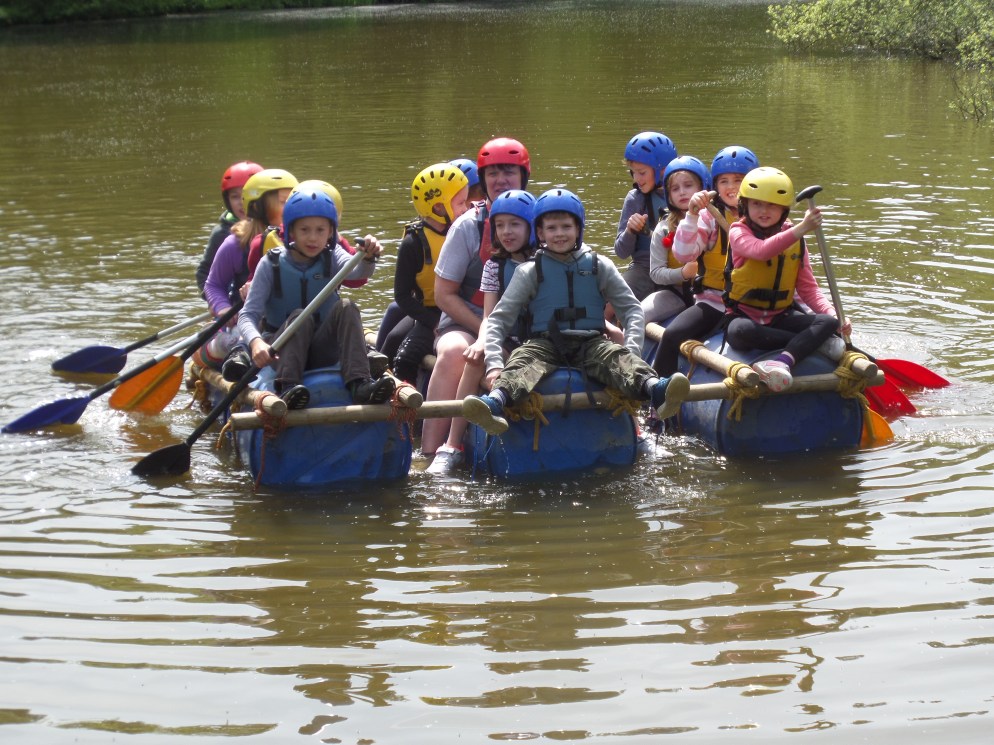
Having been shown these steps, wearing hard hats and buoyancy aids, the children set about constructing their raft. The instructors were extremely impressed by both the children’s teamwork and the way they had picked up the knot making. They could not believe that they were only 8 and 9 years old.

SAMSUNG CAMERA PICTURES
Box lashing

The work put in at the beginning in planning and developing a model to follow, now paid off, as building the actual raft became much simpler. Soon it was time to take it to the edge of the pond, to see if it actually floated.

This slideshow requires JavaScript.

The objective of the whole process had been to produce a craft that floated and would carry 13 children and an adult around the small island in the pond. This was the success criteria and, according to Joe from Freax Adventures, had rarely been achieved, and certainly not by children as young as ours.

Still, we were feeling confident, and after a brief lesson in how to row forwards and backwards and turn from left to right, the children set off on their epic journey with Mrs Stevenson planted in the middle row and Joe leading the way and shouting out instructions from his canoe.

I was amazed how coordinated the children were – personally I have never managed the technique, and only ever seem to row in circles. Not so our intrepid Year 4s though, and soon they were on their way back, having circumnavigated the island.

If I had known what a success it was going to be, I would have definitely have swapped with Mrs Stevenson – but someone has to do the filming!

SAMSUNG CAMERA PICTURES
A completely dry landing – very different from last year when everyone fell in!

The second group of 13, with Mrs Pecora in charge, were equally as successful and rowed around the entire island without capsizing – much to the chagrin of some of them.

Group 2

Still, they did make up for it by going in for a second time and leaping off into the very cold and distinctly murky water.

Mrs Pecora just loves getting wet!


Recording in Log Books

I am sure that there will be a number of people out there wondering how we actually record engineering activities in our log books, so I thought I would post an example of work done following the recent Fluor catapult challenge.

The key to making our project a success at Rode Heath has always been to try and incorporate engineering into existing lessons, wherever possible. Most engineering tasks can be linked to at least one other core curriculum subject; whether it is extending a science lesson by looking at the application of scientific ideas; making notes on the successes and failures of an activity in Literacy; or using formulas in maths to work out cost implications versus product success.

This engineering challenge had clear links with maths. Indeed there was a table provided in the activity for children to work out which catapult was the most successful, based on distance travelled against cost of materials – something that engineers continually have to think about when designing real-life products.

Below are some examples from a Year 4 log book of how this activity was captured – in a Literacy and maths lesson.


This slideshow requires JavaScript.

Alongside all of this, will have been the discussions taking place amongst the teams; the hands-on experimentation as the children adapted and improved their products and the sheer joy when the ball actually landed in the basket – all of these valuable lessons for the children to learn.

Of course, the engineering work could just as easily be recorded in the book associated with that lesson – and it frequently is.

Take this Year 1 work from their recent Super Hero project – a great example of engineering, but produced during a Literacy lesson.

And, in Year 2, teachers used the Literacy lesson to write a recount of how the children had made rubber-powered boats – part of their Inventions project.

We are now developing some stickers, so that it will be very evident where engineering is being used across the curriculum.

It’s all about being creative – thinking like an engineer, in fact!


Spring Big Tinker

Spring term was very busy for all teachers. Not only was it very short, but we had reports to write, parents’ evenings and assessments to administer and mark.

Nevertheless, in the juniors, we managed to hold one of our regular Big Tinker sessions – albeit during the last week of term. For those of you new to our project, this is something we aim to do once a half-term which is in addition to our practice of including Engineering Habits of Mind in our every day lessons.

A Big Tinker can last an hour or an afternoon. It is a time when we take a break from the rigours of the curriculum and focus on a problem solving activity, which involves us ‘thinking with our hands’. Most of the time, we find that we end up covering many curriculum objectives – just in a more creative and stimulating way.

There are plenty of activities on the Internet that you can choose from. I decided to take part in this year’s Fluor Challenge – an annual engineering event which thousands of children participate in, all over the globe:

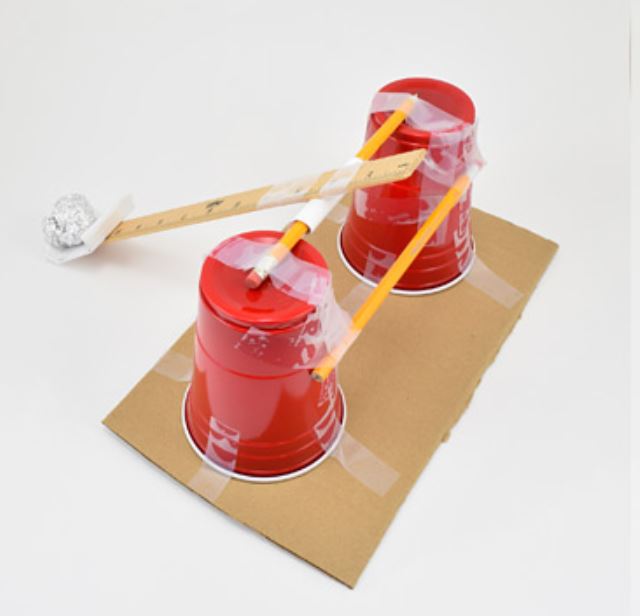
The website offers useful videos and detailed instructions as to how to proceed, and the materials required are all very inexpensive – things that you can probably find in the classroom. This year’s challenge was to make a ball launcher, using cups, pencils and rulers.

Ball launcher

The activity provided many learning opportunities for the children.

First, it offered a great opportunity to talk about simple machines, like the lever or the inclined plane. This led to the concept of projectile motion. How does the initial velocity (starting speed) and launch angle (angle at which an object leaves the launcher) of a projectile affect its range (distance it travels)? What trajectory (path through the air) will make it easier to catch the ball? A high, steep trajectory or a low, shallow trajectory? All things that make great scientific investigations.

There was plenty of maths for the children to get their teeth into as well.

Calculations

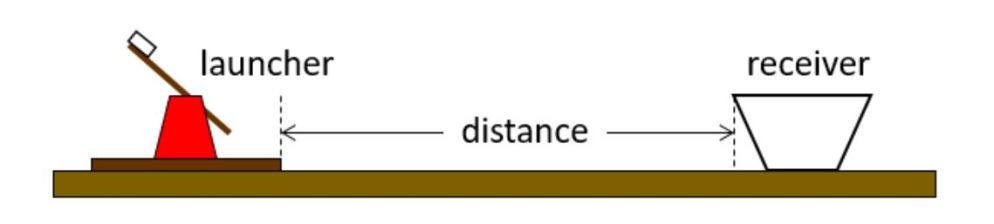
The materials used to build the launcher incurred a cost. This was then used in an equation to generate a score:

Total score = 50 x (distance in centimetres) – materials cost

The objective was to get the ball into the pot.

Obviously, we tried this out at a staff meeting before the event, to check that it was feasible. Much merriment ensued – and a good deal of competition.

We discovered that it was actually quite difficult to get the ball into the receiver, but when it happened the sense of achievement was something else! Anyway, we decided that it was definitely a session that the children would enjoy and benefit from.

We made the right decision. What a great activity it was to end the term with. The children were totally absorbed in their designs. We just gave them the materials and the problem and then left them to develop their own solutions – unlike the teachers, who actually had the benefit of the instructional video! The results were very encouraging. Children persevered and worked cooperatively in teams. They thought about the problem they were trying to solve and used the materials appropriately, producing many different designs.

What delighted me most was the fact that the children were not satisfied with their creations. At the end of the session in Year 4, they particularly asked their teacher, Mrs Pecora, if she could make sure that the catapults were not thrown away during the holidays, as they wanted to adapt them when they returned after the Easter break, to see if they could achieve a better result. For me, this is a fantastic success – children hungry to improve their work. This has to be down to our encouraging them to think like engineers.

We will definitely be returning to this in the summer term and taking advantage of the mathematical opportunities the activity offers – I can’t wait to see what the children record in their log books.

Being part of the first Greater Manchester Engineering Challenge (GMEC18)

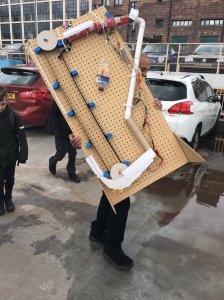
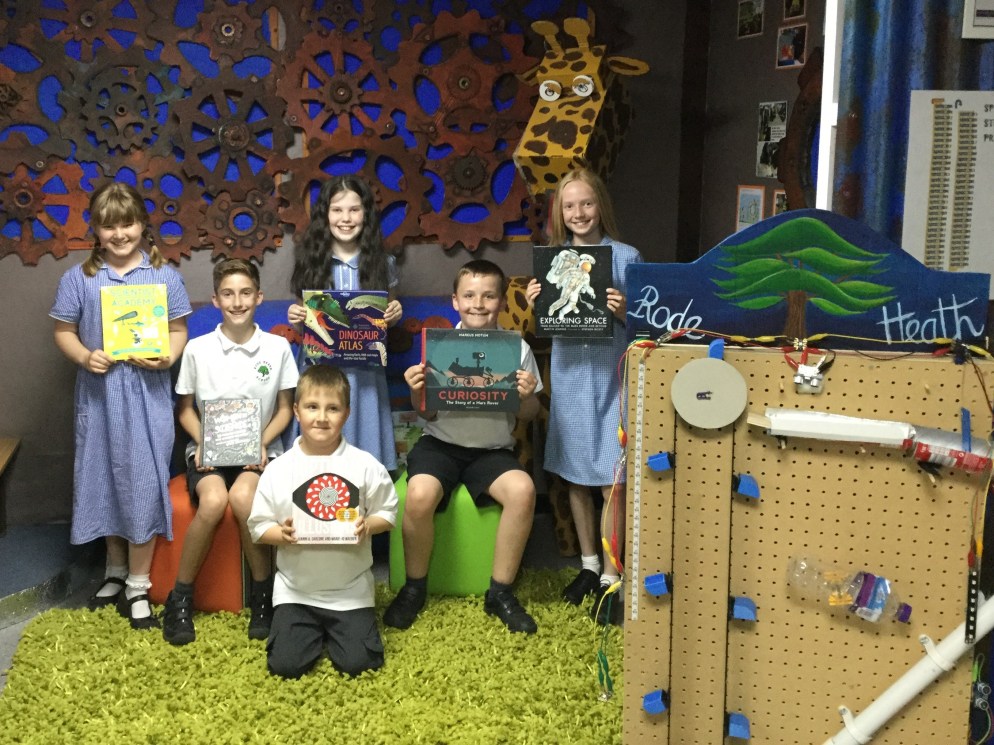
This month has been taken up with adding our final touches to our Marble Revolver – Rode Heath’s entry to the Greater Manchester Engineering Challenge. This project follows on from Tinker Tailor Robot Pi  which Rode Heath has been actively involved with for the past two years and which culminated in the creation of the hugely successful Manchester Robot Orchestra –  https://www.youtube.com/watch?v=xfchOSrXeXs

It is hoped that the Marble Run will be the first of a series of annual challenges each aimed at engaging primary and secondary pupils and their teachers in the engineering design process.

The competition was divided into four distinct categories: computing, science, D&T and literacy. Participating schools had to design their marble runs with one of these in mind. As we already had some experience with the Crumble Controller, Mr Randall and I decided to focus on the computing category. This required us to build a marble run and then automate it. Sounds simple? Well it was a lot more challenging than we anticipated. And, I hate to think how many batteries we have consumed in the process.

Fortunately, schools were supported in their efforts and in January we took some Year 4 children to a meeting in Manchester University which you can read more about in our January post. Since then, the Year 3s, 4s and 5s have worked hard to overcome problems and come up with a working machine. The finished product certainly looks very different to the sparse pegboard featured in our previous post.

The key to the design was coming up with a way in which the marbles would continue to travel around the track. Many intriguing ideas were put forward and eventually we decided on a pulley system, driven by a motor.

examples of y4 marble run homework

We were having problems with our initial cardboard buckets, so the Year 5s were challenged to design a 3D version, which they did brilliantly. In fact, the whole process was a great KS2 engineering collaboration.

The criteria for the computing category were as follows:

  • Use at least one input (switch, distance sensor etc) and/or output (motor, light etc)
  • Have an element of automation (g. automatic release of marble; sensing as the marble passes points etc)

We decided to use a distance sensor to start the pulley working – which actually saved quite a lot of battery power. People had to work past the marble run in order to activate it. This caused quite a lot of amusement for the Rode Heath pupils as staff did not realise what was happening and were spotted peering at the contraption in wonderment – this became especially funny when we played back footage from the secret camera we had installed.

Another sensor was used to trigger a chime bar (stirring fond memories of our Strike a Chord Robot). When the marble passed under the sensor, this caused the chime bar to lift to let the marble pass, but not before it had collided with the bar giving a pleasing dinging sound.

Getting this second distance sensor to work proved the most challenging aspect of the marble run. In retrospect, it was probably not the best one to choose, but we persevered and in the end devised a wooden flap which was lifted by the bucket and triggered the sensor once the marble had passed. This actually worked quite well, as it gave some time for the marble to hit the chime bar before it lifted.

The children have certainly been completely enthralled by the process. It was so difficult to choose who to represent the school at the final Manchester event. Everyone had played a part. Indeed, not a week went by without a pupil coming to show me a marble run they had made, or a poem they had written about the marble run.


Competition Day

The day finally arrived and all problems seemed to have been ironed out – apart from the logistics of actually transporting the beast. We decided that the only feasible means of travel was by car. Lugging the pegboard – which was very heavy – up and down the stairs at Sandbach and Piccadilly station, was quickly dismissed.

Manchester University had kindly provided us with free parking at Charles Street – close to Sackville Street – although we could only find spaces on the top floor, which was far from ideal.

Mr Randall manfully carried the board to the lift and after some negotiation across a couple of streets, we arrived at the Great Hall.


The quality of the marble runs was truly amazing, and all were very different. Some schools had focused on the D&T aspect, some on computing and there were some excellent videos that had been made as part of the Literacy category.

Our Rode Heath marble run quickly drew the crowds and proved very popular with the other schools. Mr Randall and I were very proud of the children, who articulately explained how the marble run worked and talked with confidence about how we had solved the various problems that had been encountered.


positive comments from the judges

The judges were very impressed by the amount of technology that we had incorporated and were particularly taken by the 3D printed baskets that the Year 5s had produced.

We had to vote for our favourite marble run, which was very difficult as they were all amazing, as you can see from the pictures below:

This slideshow requires JavaScript.

The overall prize was won by Bowker Vale school whose marble run emitted a spectacular glitter explosion at one point. We felt that our entry was the pupils’ choice though and were very proud of all our efforts.

A PowerPoint showing our marble run journey can be seen below:-

Rode Heath presentation

And here is a video of our marble run in action:-

Schools can still take part in the marble challenge. To find out more follow this link: https://seerih-innovations.org/tinkering4learning/project/the-greater-manchester-engineering-challenge/


Learning about the 5 Whys with Siemens


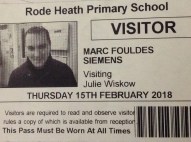
For the wholIMG_7227e of Thursday, Year 5 worked with Marc Fouldes from Siemens on their problem-solving skills. The focus of all the sessions was about finding out why problems occur and then developing solutions.

We started off with some warm-up activities.

Firstly, the children were challenged to think outside the box – literally. They had to draw four straight lines through a 3×3 matrix of dots, without taking their pencil off the paper. This proved quite difficult as the children just wanted to stay within the square structure.

The children were then introduced to the 5 Whys – a repetitive questioning technique used in business to explore the cause-and-effect relationships underlying a problem. The objective is to work out the root cause of a problem by repeating the question “Why?” Each answer then forms the basis of the next question.

An example of the problems that Year 5 came up with was not being able to get up in the morning:

Why? – because I was tired
Why? – because I went to bed too late
Why? – because I was watching TV
Why? – because I could
Why? – because no-one had told me to go to bed

It was decided that the solution would be to have a set-time for going to bed during the week, which was earlier.

The next task was designed to demonstrate to the children why standardisation is so important in business. To do this, they were asked to draw a pig (viewed from the side).

This caused a great deal of merriment – particularly over the teachers’ attempts – although Mr Scott’s SupaPig drew some complimentary comments. It soon became clear however that all the pigs were very different, as we had been given no rules or instructions as to how to draw them.

In business, this would be a very inefficient way of working, particularly if we were going to set up a pig drawing company. The children therefore decided that to help standardise the drawings they should use a grid and follow a set of instructions. Fortunately, this was the right answer and a second attempt duly followed, using said grid. This was the first time Marc had tried this activity and we decided that the American instructions, which were extremely complicated,, so Year 5 were working as guinea pigs, as well as drawing them! It was a great activity; although the instructions were very cumbersome – probably because they originated from an American website. It was agreed that they might need to be slightly modified for next time – all part of the testing and improving process.

Anyway we struggled manfully through and the revised pigs were a great success – much more uniform and therefore proving a valid point.

The key activity of the day; however, was the Marble Roller Coaster Challenge and something that the children had been eagerly awaiting. Having been sorted into teams, the children were given 15 sheets of cardboard, some Sellotape and a marble and challenged to make a structure that would allow their marble to start at the top and run down to the bottom without stopping or falling off. The adults then stood back and observed.

Everyone worked well together, producing rough designs and a prototype, before looking at any problems that had occurred and adapting their designs to build a more finished product. All the creations were very different: some groups even attempted building a loop the loop into their design – quite a difficult undertaking.

It was interesting to see how far the children’s ideas had progressed from the initial Marble Run Challenge we held back in October 2016 when we launched our Think Like an Engineer project. It was also clear as to how much mileage you can achieve out of this relatively simple activity. It can certainly be repeated with the same children on many occasions – perhaps with different outcomes in mind, such as a maths or computing focus, or a specific objective such as creating a run in which the marble takes a defined number of seconds to reach the bottom. Ultimately, it is the reaction and the engagement of the children that is key – and, of course, whether they are learning anything valuable.

This slideshow requires JavaScript.

It is our great belief at Rode Heath that children learn best when they are actively engaged in their learning, so today certainly ticked that box. The Year 5s were enthusiastic, on-task and showed a willingness to improve and build on their initial prototypes – all good Engineering Habits of Mind. In fact, at the end of the day the response was – when can we do this again?

Whilst the marble run was going on, in the middle area, teams of 12 engaged in yet another team building activity: the Tower of Power. This involved the children trying to lift a set of bricks using a hook and a network of strings. They had to move them from one location to another, placing them on top of each other to form a tower. This was a difficult exercise. Everyone had to hold their strings tightly and move in unison; otherwise the bricks either fell off the hook, or the tower toppled over.

Amazingly, one of the Year 5 teams was successful and managed to put all 8 bricks on top of each other. Another great opportunity to think like an engineer.

As Marc Fouldes very aptly commented “Teamwork makes the dream work!”

Thank you Siemens for contributing to our Rode Heath vision.


Happy New Engineering Year 2018

When can you stop saying “Happy New Year” to people you meet? I guess it has to be the end of January. This does however promise to be an exciting new year for engineering – full of opportunities. And, with signs that Ofsted are now advocating “a full and varied primary curriculum”, it’s a perfect time for schools to enrich their lessons by encouraging children to think like engineers.

So what has been happening in January at Rode Heath Primary. Our relationship with Engineering Habits of Mind continues to thrive, with teachers now weaving engineering into their every day lessons. Our spring curriculum brochures are full of engineering ideas.

Years 1 & 2 have already entered a competition to design a piece of technology of the future. Here are a few of the Year 1 entries.

This slideshow requires JavaScript.

Reception have been busy designing and making wheeled vehicles.

Meanwhile, Mr Randall and I have embarked on another project with Manchester University – the Great Manchester Engineering Challenge (otherwise known as GMEC18).

This involves 15 Greater Manchester schools (and ourselves) competing against each other to build an automated marble run. Early in January, we took six Year 4 pupils to an event at Manchester University to take part in a number of workshops intended to give ideas for the competition. Watch the film here:

For two Monday afternoons, we have been gathering in Mr Randall’s classroom to try out different materials and practise our Crumble skills (and I don’t mean domestic science).

At the moment, in front of our Machine Room, a prototype board is standing, to which different contraptions seem to be added everyday. I don’t know how we are going to transport this beast to the University!

UKS2 are awaiting their visit from Siemens in February. I wonder which team will win the Lego Lean Manufacturing cup this year?

Kite Engineering

This week we held our first whole school Engineering Day of the autumn term, and the theme was ‘kites’. This time, we had enlisted the help of Pauline Taylor, a specialist kite maker from http://infinitearts.co.uk/.

She led a twilight staff meeting the previous Thursday, to prepare us for the main event. To be honest, I was somewhat concerned, asking staff to stay behind for yet another evening. However, I needn’t have worried – it was hilarious! Over the course of two hours, we made kites of varying difficulties and then ran around like mad things in the pitch black, trying to fly them – some more successfully than others.

Tetrahedral kite

Curriculum Links

You may be surprised to learn how cross-curricula kites are.

First, there is the history of kites. They were the first flying devices ever made by humans and appear to have originated in China over 2,000 years ago – mainly due to the prolificacy of silk and bamboo from which the kites were made.

One of the most famous kite flyers of all time, was ten-year old, Homan Walsh, who was instrumental in the construction of the Niagra Falls bridge. During a competition, Homan successfully flew his kite from one side of the gorge to the other. Once the kite line was secured, heavier and heavier line was fed across, until a steel cable could be connected across the gorge to allow the bridge construction to begin.

Alexander Graham Bell, famous for the invention of the telephone, had a great passion for both aeronautics and kites and was also known for his experimentation with very large man-lifting kites: https://publicdomainreview.org/collections/alexander-graham-bells-tetrahedral-kites-1903-9/

Alexander Bell Kite

These were based around tetrahedrons, one of nature’s most stable structures, which leads us nicely  to the maths elements of kite making: symmetry, measuring, ratio, scale and proportion, angles.

maths

Kite-making has strong links with science, particularly forces. There are two main principles involved in the aerodynamics of a kite: the first is Newton’s Third Law of Motion and the second is Bernoulli’s Theorem. This offers opportunities for children to develop their questioning skills. Does increasing the surface area of the kite improve the way it flies? What happens if we change the fabric?

We intended to look at many of these aspects both before and after the main event . . .

Kite Day

As with all our whole school engineering days, we invited parents to come and work with their children. This not only allows us to share our engineering vision, but also provides teachers with an extra pair of hands, which is always useful.

The day started with a short assembly by Pauline, who wowed us with her magnificent display of kites. She told the children that although she had thought she was primarily an artist, she now felt that she was an engineer, as she was making kites and then adapting and improving them – something that engineers do all the time.

Following the assembly, we all went back to our classes, were the making began. The plan was to make three different types of kite of varying degrees of difficulty: Diamond, Sled and Vietnamese. Each key stage was allocated a particular model to try.

This slideshow requires JavaScript.

There were detailed instructions, and all the materials had been previously supplied by Pauline – even down to the Sellotape dispensers – so we were ready to go. We were all initially making the kites out of colourful plastic bags that had been cut to the correct size (for the lower key states, anyway!) To cover costs, this time we had asked each pupil for a contribution of £3, which helped finance the event.

The children worked enthusiastically together, measuring their bridles and flying lines, tying knots and attaching bamboo to provide structure to their kites. Having secured their tails, a key factor affecting stability, they were all keen to test out their creations.

The wind was not as strong as we might have liked; however, it was a beautiful sunny day, and once safety instructions had been read and digested, we ventured outside with our kites. Fortunately, classes finished the making process at different times, so we were able to stagger the flying experience and avoid most tangles: although a few over-enthusiastic pupils had to have their kites rescued from trees.

The children soon learned that it was best to fly into the wind and that longer tails made for more stable kites. There was certainly a lot of physical exercise in evidence. Ideally, you shouldn’t run with a kite, but the desire to get them airborne was too great.

After lunch, time was allocated for modifications and improvements, then back out to test again . . .

It had been a wonderful day, full of valuable learning.

In 1760, kites were banned in Japan because too many people preferred flying them to working. I can see why.
Engineering Twilight at Rode Heath

This week, the government announced that 2018 will be the Year of Engineering: a national campaign to increase awareness and understanding of what engineers do, among young people aged 7-16, their parents and their teachers. This presented an excellent opportunity for us to promote the huge role that engineering plays in society and the benefits of teaching our children to adopt the skills that engineers use in their day to day tasks.

Year of Engineering

With this in mind, on Thursday night, we held an Engineering Twilight for Cheshire East schools to share the work we have been doing at Rode Heath with our Think Like an Engineer project. The evening focused around introducing the concept of Engineering Habits of Mind (EHoM) and how we have introduced them into our curriculum through our Engineering Log books.

As the night was all about the impact the project has had on our children, the event started off with an excellent presentation by Daniel Smallwood and Ellie Jepson, entitled “From paperclips to spaceships.”  They talked about what engineering meant to them and how using EHoM has helped their learning.

DS & EJ

Much to our delight, the evening was very well attended, with a mixture of 32 Heads and teachers from 14 different schools. We were also pleased to welcome representatives from the Civil Engineering company Jacobs Ringway, the Skills & Growth organisation and the Crewe Pledge.

The State of Engineering

In the latest Engineering UK Report on the state of engineering in the UK, it has been estimated that we will need 186,000 skilled entrants to meet the demand for engineering enterprises up to 2024. Most effort seems to be currently focused on secondary students, but it is at primary level that children’s enthusiasms and passions need to be captured and channelled.

The Engineering Habits of Mind developed by the Royal Academy of Engineering in 2014 are key skills for learning and it is these habits that we have been encouraging our children to adopt at Rode Heath.

Engineering habits

Undoubtedly, there will be scepticism as to how, yet another subject can be squeezed into the already overcrowded curriculum; however, the beauty of Engineering is that is not only offers the opportunity to reinforce content, but allows children to develop mastery in a subject by applying their knowledge. Engineering Habits of Mind allow children to develop higher order thinking skills. When they are engineering they have moved from merely remembering and understanding to applying and ultimately creating.

blooms_old

We know that children learn best when they are actively involved in their learning. And, learning is most valuable when children are designing, building and making something. Schools generally do this well in Reception, but it seems to tailor off as children move up the school and priorities change.

At Rode Heath, we believe in offering children an environment where, through purposeful engineering activities, they experience hands-on application of concepts learned in other subjects. Our Twilight session allowed our pupils to share many of the skills that they have developed over the past academic year as a result of our commitment to Engineering. These ranged from using a range of micro-computers (Lego Wedo, Crumble Controllers, CodeBugs and Micro:bits) to learning about gears, levers and hydraulics with K’nex.

In the middle area of the school, teachers were treated to a demonstration of how to link Engineering to Literacy: giving children the chance to solve the problems faced by characters in their stories using an engineering solution – sometimes with a finished product (using 3D printing), but more often that not with a visualisation of their ideas.

Engineering links to science and D&T were also on display. The Scribble-Bots proved very popular with the teachers, and we had to quickly discourage our children from giving away too many motors.
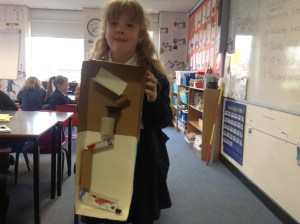
Not to be outdone, in the corner loomed the Reception dinosaur, complete with pulley system and bucket – (well how else does a small child feed a dinosaur?). According to Mrs Woollam, this is a favourite activity of the children, who often spend more than 45 minutes at a time tackling the problem; refusing to give up, until they have worked out how to successfully set up the pulley.

At the end of the evening, the event was hailed to be a great success, with teachers impressed both by the confidence and eloquence of our children, and the quality of work in their books – particularly KS1.

We are hoping that this positive response will result in some of these schools taking up our offer of workshops, designed to start them on their Engineering journey.

We know that it works. The impact on our children over the past year has been palpable – increased resilience; increased imagination; increased belief in what they can achieve.

2016072458-sketch-kids-chartBy promoting Engineering Habits of Mind as a way of learning, we are providing our pupils with skills that they will need for the careers of the future.

And, as educators, this should most definitely be our goal.

STEM alive at RAF Cosford

RAF Cosford

Yesterday, Rachel Woollam, John Randall, his son Benji and I, were lucky enough to be invited to RAF Cosford to have a look at their innovative STEM bus. And, what an amazing experience it was. We were greeted initially by Corporal Mathew McNee who took us to obtain our passes for the day. It made us all feel very important. To prove our identities we had to provide some documentation – Benji’s was deemed to be the most trustworthy, as he had a special Blue Peter badge winner’s card.

RAF Cosford passAfter yet another terrible photograph, we made our way across the base to meet Flight Lieutenant John Sloley, who together with Mat, runs the STEM bus.

This is a double decker bus dedicated to bringing STEM activities to the local community, particularly school children. We were very excited to have a closer look, as this is a resource that we are planning, with the help of our PA, to establish at Rode Heath. Although ours will remain static, this RAF bus is able to travel within a 30 mile radius and offers a wide variety of engaging learning activities such as Aeronautical Engineering, Virtual Reality and Robotics, as well as having a play area available for toddler crafts.


We were certainly very impressed by the technology we found in the interior. There were a number of large screens with access to the Internet, which meant that we were able to show off our Think Like an Engineer website and bring up an aerial view of the school to see where we might house a similar vehicle. At over 18 metres long and around 2.5 metres wide, it is quite a large undertaking – definitely requiring some thought!

Map

The bus was very well equipped, the screens being particularly useful for giving presentations and directing children’s learning – we would certainly need to budget for at least one of these in our bus to deliver workshops and CPD. As we walked through the different areas we could see more and more potential for the work space: staff meetings, Code Club; birthday parties; PPA etc.


This slideshow requires JavaScript.

Having investigated the bus and made extensive notes, we were then treated to a peek inside the geodesic dome, which houses a massive radar scanner. This powerful piece of equipment uses microwaves to determine the range, angle, or velocity of planes detected within a 250 mile radius. This is one of a number mobile RAF scanners located across the UK, helping to defend us.


Watching it operate was very impressive.


Benji was even given the opportunity to switch the radar on and try out the software – he was a natural. There certainly seemed to be a considerable number of planes in the sky at that moment.


It was a fantastic end to the morning. Having said our goodbyes to John and Mat, whilst Rachel and I headed to the Museum restaurant for a bite to eat, John took Benji to look at the planes and other wonderful attractions.

Thank you John and Mat for making us so welcome and sharing your STEM visions with us. You have given us a lot of food for thought and armed us with huge enthusiasm for the future. We now need to retreat and form our plan of attack.

And, of course, find a suitable bus . . . . and maybe some sponsors, as we have quite ambitious ideas.